
The index fund industry continues to reshape how Americans invest, with over $7 trillion now parked in passive U.S. equity index funds as of early 2026. For investors tracking their portfolios or considering where to allocate new capital, staying current with index fund developments—from fee changes to performance shifts—directly impacts long-term wealth accumulation.
What Are Index Funds and Why They Matter
Index funds are investment vehicles designed to replicate the performance of a specific market benchmark, such as the S&P 500 or the total U.S. stock market. Unlike actively managed funds where portfolio managers select individual stocks, index funds automatically hold all (or a representative sample) of the securities in their target index.
The appeal centers on three core benefits: lower costs, tax efficiency, and consistent market-matching returns. Because there’s no expensive research team picking stocks, expense ratios typically run between 0.02% and 0.20% annually—a fraction of the 0.60% to 1.50% charged by many active funds. Over decades, these cost differences compound significantly.
Index funds matter because they’ve democratized investing. A teacher in Ohio and a software engineer in California can access the same institutional-quality diversification that pension funds use, often with no minimum investment requirement at major brokerages. When news breaks about fee reductions or new fund launches, it directly affects the tools available for building retirement security.
Recent Index Fund Performance and Returns
The first quarter of 2026 brought mixed results across index fund categories. Broad market funds tracking U.S. equities posted modest gains, though performance diverged based on market capitalization and sector exposure.

S&P 500 Index Fund Performance Highlights
S&P 500 index funds delivered approximately 3.2% returns through March 2026, continuing the market’s recovery from the volatility experienced in late 2025. Technology sector strength offset headwinds in consumer discretionary stocks as interest rates stabilized.
Vanguard’s 500 Index Fund (VFIAX), Fidelity’s ZERO Large Cap Index (FNILX), and Schwab’s S&P 500 Index Fund (SWPPX) all tracked their benchmark within 0.05%, demonstrating the precision of modern indexing. Investors who maintained positions through the previous year’s 8% drawdown have now recovered those losses and added modest gains.
The S&P 500’s concentration risk remains a talking point. The top ten holdings—dominated by technology companies—now represent roughly 32% of the index weight, meaning a third of your S&P 500 index fund investment sits in just ten stocks.
Total Market Index Fund Updates
Total market index funds, which include small- and mid-cap stocks alongside large companies, slightly underperformed their large-cap-focused cousins in early 2026. Funds tracking the CRSP U.S. Total Market Index or similar benchmarks returned approximately 2.8% through March.
This performance gap reflects ongoing investor preference for established large-cap companies during periods of economic uncertainty. However, total market funds provide broader diversification across roughly 3,600 stocks compared to the S&P 500’s 500 holdings.
Vanguard Total Stock Market Index Fund (VTSAX) and Fidelity Total Market Index Fund (FSKAX) both saw substantial inflows in January 2026, with combined net new assets exceeding $12 billion as investors rebalanced portfolios at year-start.
New Index Fund Launches and Product Changes
The passive index fund investing landscape saw notable developments in recent months, with providers competing aggressively for market share.
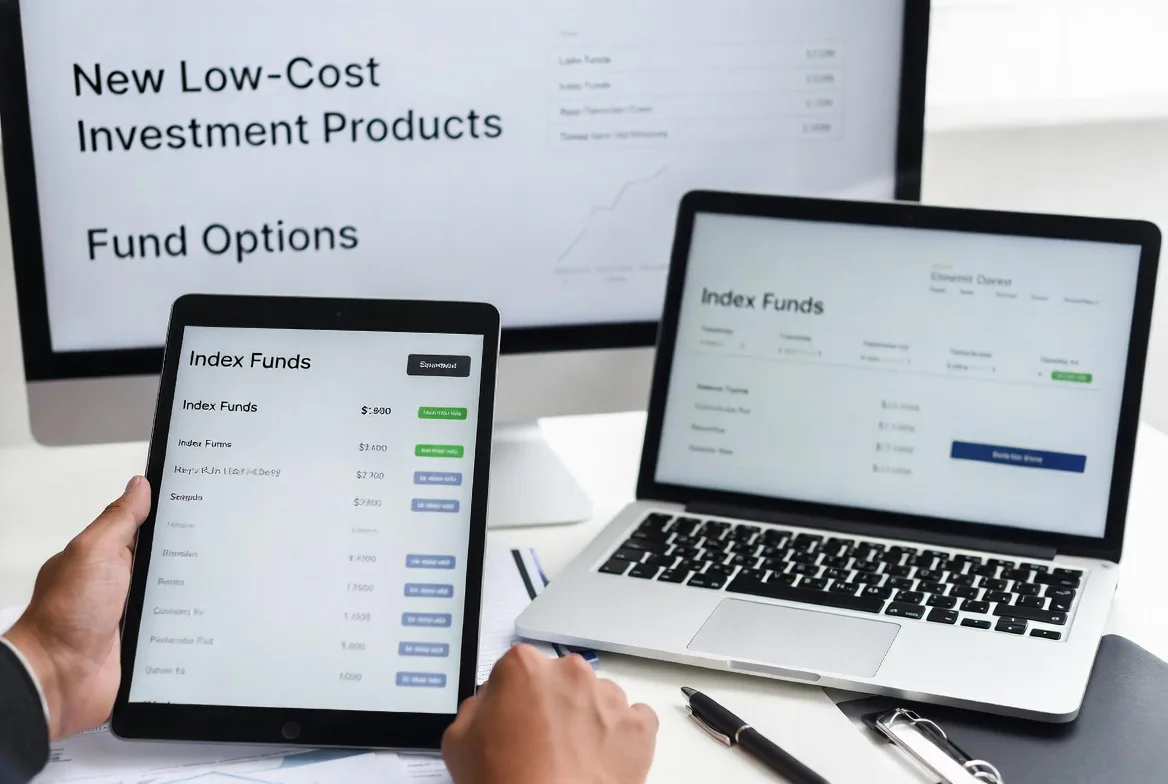
In February 2026, Fidelity expanded its ZERO expense ratio fund lineup, launching the Fidelity ZERO International Index Fund (FZILX). This marks the first time U.S. investors can access international equity exposure with literally zero annual fees—a milestone that pressures competitors to reconsider their pricing.
Vanguard announced the merger of two sector-specific index funds in January, consolidating its Telecommunications Services Index Fund into the broader Communication Services Index Fund. Existing shareholders received automatic conversions with no tax consequences, streamlining Vanguard’s product shelf.
BlackRock’s iShares division introduced a U.S. Quality Dividend Index Fund in March 2026, targeting investors seeking both passive index fund investing methodology and income focus. The fund tracks an index of approximately 200 dividend-paying companies with strong balance sheets, charging a 0.15% expense ratio.
State Street Global Advisors quietly reduced minimum investment requirements across its SPDR index fund lineup, dropping from $3,000 to $1,000 for most funds. This change opens access for younger investors building initial positions.
Index Fund Fees and Cost Trends
The fee compression story continues, though the pace has slowed from the dramatic cuts seen between 2018 and 2024. We’ve entered what industry analysts call the “basis point endgame”—where further reductions become mathematically difficult.

The table below shows current pricing among major S&P 500 index fund providers:
| Provider | Fund Name | Expense Ratio | Minimum Investment | Assets Under Management |
|---|---|---|---|---|
| Fidelity | ZERO Large Cap Index (FNILX) | 0.00% | $0 | $38 billion |
| Vanguard | 500 Index Fund Admiral (VFIAX) | 0.04% | $3,000 | $512 billion |
| Schwab | S&P 500 Index Fund (SWPPX) | 0.02% | $0 | $87 billion |
| BlackRock | iShares Core S&P 500 ETF (IVV) | 0.03% | 1 share (~$520) | $461 billion |
The practical difference between a 0.02% and 0.04% fee on a $50,000 investment amounts to $10 annually—meaningful over decades, but not a deal-breaker for most investors already at a preferred provider.
More significant than expense ratio changes are the hidden costs that rarely make headlines. Securities lending revenue (where funds lend holdings to short sellers for fees) now offsets expenses at several providers. Vanguard returned approximately $140 million to index fund shareholders through securities lending in 2025, effectively reducing net costs below stated expense ratios.
Regulatory developments may impact future fees. The SEC proposed new rules in late 2025 requiring clearer disclosure of “total cost of ownership,” including trading costs and market impact expenses. If implemented, this could reveal that some ultra-low-fee funds actually cost more to own than their expense ratios suggest.
Index Fund Strategy Shifts and Industry Trends
Passive index fund investing no longer means simply tracking market-cap-weighted benchmarks. The industry has evolved toward what some call “strategic indexing”—rules-based approaches that introduce modest tilts while maintaining low costs.
Environmental, social, and governance (ESG) index funds attracted $42 billion in new assets during 2025, though growth slowed from previous years. Providers now offer dozens of ESG index variations, from broad market screens to specialized climate-focused indexes. Vanguard’s ESG U.S. Stock ETF (ESGV) charges just 0.09%, demonstrating that values-based indexing needn’t sacrifice the cost advantage.
Factor-based index funds—targeting characteristics like value, momentum, or quality—gained traction among advisors seeking middle ground between pure passive and active management. These funds follow transparent rules but deviate from market-cap weighting. The trade-off: slightly higher fees (typically 0.15% to 0.35%) and potential tracking error versus broad market benchmarks.
Direct indexing emerged as a threat to traditional index funds for wealthy investors. This approach involves owning individual stocks that comprise an index rather than fund shares, enabling tax-loss harvesting on specific positions. Costs have dropped enough that investors with $100,000 or more can access direct indexing, though most Americans still benefit more from conventional index funds’ simplicity.
Cryptocurrency index funds remain in regulatory limbo. While several providers have filed for crypto index fund approval, the SEC has yet to greenlight these products as of March 2026, leaving crypto exposure outside traditional index fund wrappers.
Index Funds vs Active Funds: Latest Research and Debates

The evidence supporting index fund investing over active management strengthened in recent research. S&P Dow Jones Indices’ 2025 SPIVA report (released January 2026) found that 88% of active large-cap U.S. equity funds underperformed the S&P 500 over the trailing 15-year period—consistent with long-term trends.
However, active managers showed improved relative performance in small-cap and international markets. Only 72% of small-cap active funds trailed their benchmarks over ten years, suggesting skilled managers can add value in less efficient market segments.
The active-passive debate misses the point. Most investors should own index funds as portfolio core holdings, potentially complemented by active strategies in specialized areas where manager skill matters. The question isn’t either-or—it’s how much of each.
Christine Benz, Director of Personal Finance at Morningstar.
Tax efficiency continues tilting the scales toward index funds. The average actively managed equity fund distributed capital gains equal to 6.8% of net assets in 2025, forcing taxable investors to pay taxes on gains they didn’t choose to realize. Most broad market index funds distributed zero capital gains, preserving tax deferral.
Active fund advocates point to 2025’s volatile market as evidence that human judgment matters. Several active managers successfully reduced technology exposure before the sector’s summer pullback, protecting client capital. Yet for every manager who timed this correctly, others increased tech holdings at precisely the wrong moment—reinforcing the difficulty of consistently beating indexes.
The fee gap between active and passive continues widening. The average actively managed U.S. equity fund charged 0.68% in 2025, while the average index fund cost 0.06%—an 11-fold difference. Even active funds that outperform their benchmarks often fail to beat index funds after accounting for their higher fees.
FAQs
An index fund is a mutual fund structure that tracks a market index, with shares priced once daily after market close. An ETF (exchange-traded fund) also tracks an index but trades throughout the day like a stock. Both can track identical indexes—for example, Vanguard offers its S&P 500 index as both a mutual fund (VFIAX) and ETF (VOO). ETFs offer intraday trading and sometimes slightly lower expense ratios, while index mutual funds allow automatic investing and fractional shares. For long-term investors, the differences matter less than choosing a low-cost option.
Expense ratio changes occur irregularly, typically when providers make strategic decisions to compete for assets. The 2017-2024 period saw frequent fee reductions as Fidelity, Vanguard, and Schwab battled for market share. Since 2025, changes have slowed considerably because fees already approach operational costs. Some providers guarantee expense ratio caps, while others can adjust fees with shareholder notice. Investors should review fees annually but shouldn’t expect frequent changes going forward.
Yes, absolutely. S&P 500 index funds carry full stock market risk. The index has experienced numerous periods of significant loss, including a 37% decline in 2008 and multiple 20%+ corrections. However, the S&P 500 has never failed to recover and reach new highs given sufficient time. Investors who needed their money during downturns suffered real losses, while those with 10+ year timeframes have historically seen positive returns. The risk isn’t whether downturns occur—they will—but whether you’ll need to withdraw money during one.
The difference is smaller than most investors assume. Total market funds add roughly 3,600 small- and mid-cap stocks to the S&P 500’s large-cap holdings, but because the market is cap-weighted, large companies still dominate. Vanguard Total Stock Market Index Fund holds approximately 80% in stocks that overlap with the S&P 500. Total market funds provide slightly broader diversification and exposure to smaller companies’ growth potential. S&P 500 funds offer marginally lower fees and simpler benchmark tracking. For most investors, either choice works well—the decision to invest matters far more than which broad market index you select.
The index fund industry’s maturation brings both opportunities and complexity for investors in 2026. Fee compression has essentially bottomed out at several major providers, shifting competitive focus toward service quality, product innovation, and specialized indexing approaches.
Recent performance data reinforces that index funds deliver exactly what they promise: market returns at minimal cost. Whether those market returns satisfy your goals depends on your timeline, risk tolerance, and savings rate—not the funds themselves.
For investors building portfolios, the news that matters most isn’t which provider cut fees by another basis point or launched the newest thematic index. It’s maintaining consistent contributions, resisting the urge to abandon your strategy during volatility, and ensuring your asset allocation matches your actual risk capacity.
The index fund revolution succeeded because it simplified investing, removing the need to identify winning managers or time market movements. As the industry evolves with ESG options, factor strategies, and direct indexing alternatives, remember that complexity often works against investors. A straightforward approach—regular investments in a low-cost total market or S&P 500 index fund—continues to outperform most alternatives over timeframes that matter for retirement and long-term goals.
Stay informed about index fund developments that affect your holdings, but avoid letting minor industry news distract from the consistency that actually builds wealth.