
Have you ever wondered who’s behind those rapid-fire trades that happen within seconds of market-moving news? Day traders live in a world where positions rarely last longer than a few hours, and every trade closes before the closing bell rings. They’re not building retirement portfolios or waiting for long-term growth—they’re extracting profits from minute-to-minute price swings, often completing dozens of transactions before most people finish their morning coffee.
Day Trader Meaning and Core Responsibilities
When someone asks “what is a day trader,” the simplest answer is this: it’s someone who buys and sells securities before the trading session ends, deliberately avoiding any overnight exposure. But what is a day trader really doing all day? Far more than clicking buttons.
Picture a trader’s morning starting around 6:30 AM Eastern time. They’re scanning pre-market movers, reading overnight earnings reports, checking Asian and European market performance, and building a watchlist of stocks showing unusual activity. By 9:00 AM, they’ve identified potential candidates—maybe a biotech stock gapping up 15% on FDA news, or a tech company showing unusual options flow.
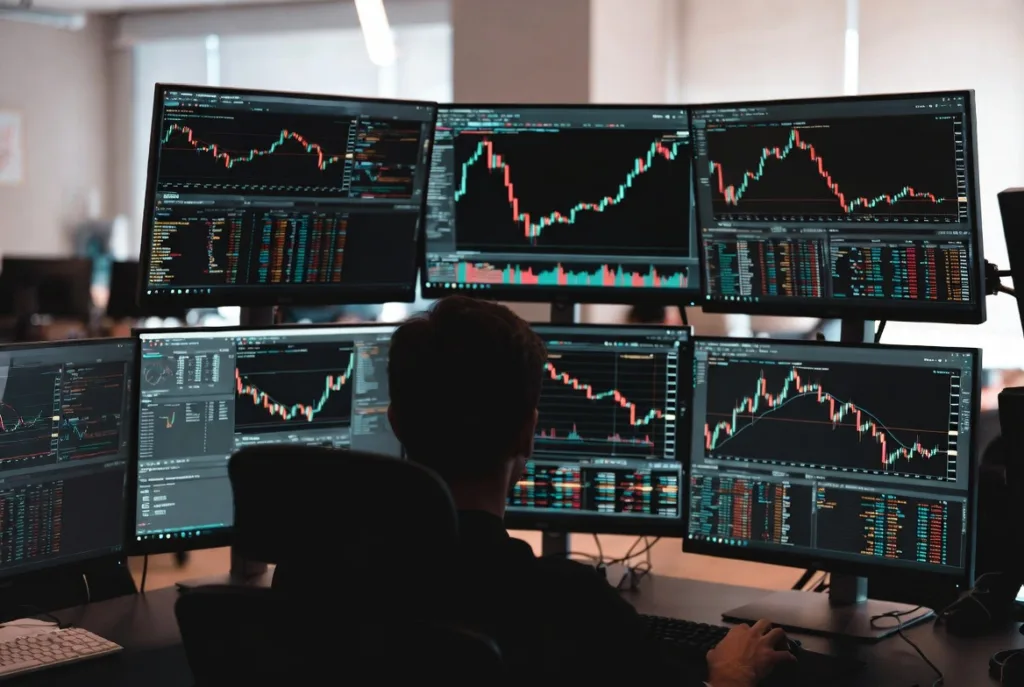
Between 9:30 AM and 4:00 PM, their workspace resembles a command center. Four to six monitors display real-time Level II quotes, multiple timeframe charts, news feeds from Bloomberg or Benzinga, and order entry tickets ready for one-click execution. They’re tracking ten or more positions simultaneously, adjusting stop losses, scaling out of winners, and cutting losers before they spiral.
Here’s what separates day traders from other market participants: swing traders might check their positions twice daily and hold through several sessions. Position traders review portfolios weekly, riding trends for months. Scalpers—a subset of day traders—hold for literally seconds or minutes, but still close everything by 4:00 PM. Day traders occupy the middle ground, holding anywhere from fifteen minutes to several hours, but always, always closing before overnight risk enters the equation.
Their responsibilities read like a job description for an air traffic controller. Maintaining strict discipline when a losing trade tempts you to “just give it five more minutes” to turn around. Sizing positions properly so no single trade can crater your account. Logging every entry and exit with brutal honesty about what worked and what didn’t. And perhaps hardest of all—continuously studying market behavior even after years of experience, because what worked in 2023’s low-volatility environment might fail spectacularly in 2026’s conditions.
Successful practitioners treat this like running a small business. They’ll dedicate 50-70 hours weekly between active trading, chart review, education, and mental preparation. It’s not a side hustle or casual hobby—it’s an all-consuming profession that demands full attention.

How Day Trading Works
The operational mechanics start with identifying liquid securities primed to move substantially during that session. Traders need tight bid-ask spreads (preferably a penny or two) and sufficient volume that their orders don’t cause noticeable price impact. A $10,000 buy order shouldn’t move the price—that’s the liquidity requirement.
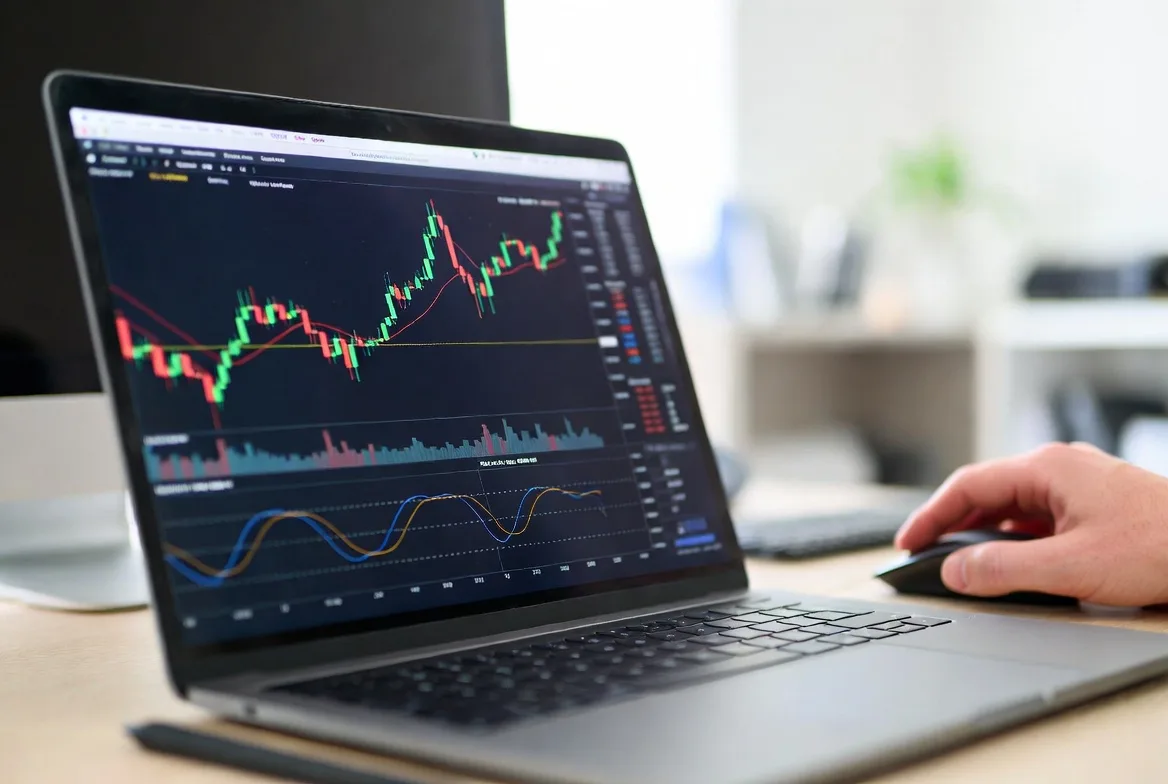
Most rely heavily on technical analysis because fundamental value matters little in a three-hour holding period. They’re watching candlestick patterns on five-minute charts, tracking volume surges that signal institutional participation, monitoring moving average crossovers, and using indicators like RSI or MACD to gauge momentum strength. Some blend in fundamental catalysts—a pharmaceutical company announcing trial results or the Fed releasing rate decisions—but the execution still depends on reading price action.
Timeframe selection varies by style. Aggressive scalpers live on one-minute or even tick charts, capturing movements measured in cents. More patient day traders operate from fifteen-minute or hourly charts while checking higher timeframes for directional bias. Many use a top-down approach: consulting the daily chart to determine if the stock’s in an uptrend or downtrend, then dropping to shorter intervals for precise entry timing.
Leverage transforms how day trading works fundamentally. Because stocks might only move 2-3% during a session, traders amplify their capital through margin. Someone with $35,000 in their pattern day trader account accesses roughly $140,000 in buying power during market hours. That 2% move on a fully leveraged position becomes an 8% account gain. Of course, it cuts both ways—a 2% loss wipes out 8% of capital just as quickly.
The execution cycle repeats continuously: scan for setups, validate against your strategy criteria, enter with a predetermined risk amount, manage the position actively, exit based on profit targets or stop losses, then immediately start scanning for the next opportunity.
Common Markets and Securities Day Traders Focus On
Equities dominate the day trading landscape, particularly stocks trading over one million shares daily with prices between $5 and $300. The sweet spot? Stocks between $20-100 with consistent volatility. Think names like Tesla on a product announcement day, or any biotech stock within 48 hours of binary catalyst events like FDA decisions.
Technology stocks—NVIDIA, Apple, Microsoft, Amazon—provide reliable action because institutional algorithms trade them constantly, creating consistent intraday patterns. Conversely, small-cap biotechs under $15 can explode 40-60% in minutes on positive news, attracting aggressive momentum traders willing to tolerate extreme risk.
Options trading attracts a different breed of day trader. Weekly options expiring in one to five days offer massive leverage—a $300 call option might control $30,000 worth of stock. When the underlying moves 3%, that option could jump 50-100%. But time decay works viciously against you, and by Friday afternoon, these options might expire worthless. It’s high-octane speculation requiring precise timing.
Futures contracts, especially the E-mini S&P 500 (/ES) and Nasdaq 100 (/NQ), draw professional traders because they operate nearly 24 hours. One /ES contract controls roughly $200,000 in S&P exposure, yet requires only $12,000-15,000 in margin. That built-in leverage, combined with favorable 60/40 tax treatment under IRC Section 1256, makes futures attractive for full-time traders. Crude oil (/CL) and gold (/GC) futures offer similar benefits with different characteristics.
The forex market’s continuous operation across global sessions appeals to traders who want flexibility beyond 9:30-4:00 Eastern hours. EUR/USD and GBP/USD pairs provide tight spreads and enormous liquidity. However, forex brokers sometimes offer 50:1 or even 100:1 leverage—wildly dangerous for inexperienced traders who can lose entire accounts on single unexpected moves.
Cryptocurrency markets never sleep, and that’s both blessing and curse. Bitcoin and Ethereum regularly swing 5-15% in 24-hour periods, creating opportunities that stock traders envy. But that same volatility means waking up to liquidated positions if you’re not monitoring constantly. The 24/7 nature attracts insomniacs and international traders across time zones, but it’s exhausting to trade sustainably.
Technology and Platforms Day Traders Use
Forget Robinhood’s basic interface or your bank’s investing tab. Professional day trading demands industrial-grade platforms like TD Ameritrade’s Thinkorswim, Interactive Brokers’ Trader Workstation, TradeStation, or specialized platforms like DAS Trader Pro used by proprietary trading firms.
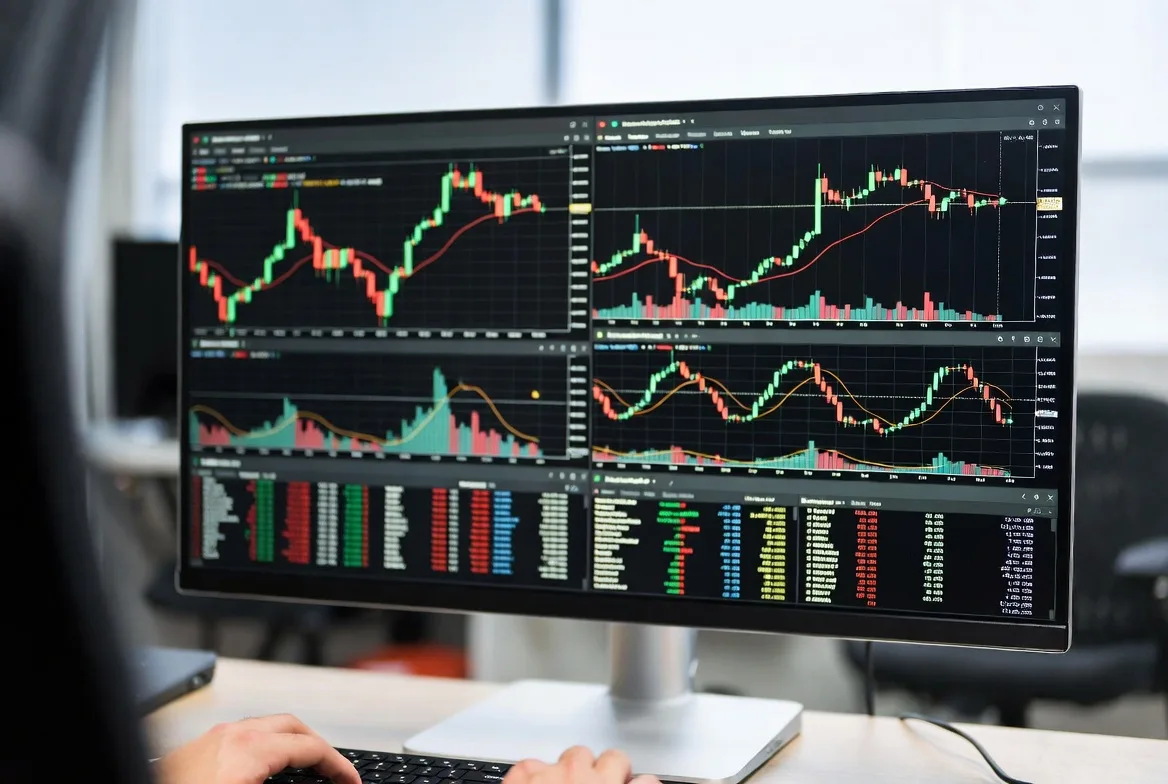
These platforms provide Level II market depth showing real-time bid and ask orders stacked at various price levels. You’ll see exactly where large buy and sell orders sit, helping predict support and resistance zones. Advanced charting tools let you layer twenty indicators simultaneously across multiple timeframes, though most experienced traders simplify to three or four key metrics.
Hotkeys become essential for speed—pressing F1 might instantly buy 500 shares at the ask price, while F2 sells your position at the bid. In fast-moving situations where a stock’s climbing 5% per minute, fumbling through menus costs real money.
The six-monitor setup has become almost cliche, but there’s practical reasoning behind it. Monitor one displays your main trading chart. Monitor two shows a watchlist of pre-selected stocks with real-time prices. Monitor three streams news from multiple sources. Monitor four contains your order entry ticket and position manager. Monitors five and six might show sector performance, market internals like advance-decline ratio, or additional charts for correlation analysis.
Internet reliability cannot be compromised. Many traders install fiber optic connections with 1Gbps speeds, then maintain a backup 5G hotspot or separate cable connection. Imagine holding a $50,000 leveraged position when your internet drops—by the time you’re back online using your phone’s hotspot, a 2% adverse move has cost you $1,000.
Real-time scanners like Trade Ideas (running algorithms that filter 8,000+ stocks every second) identify opportunities based on criteria you set: stocks up 8% on 3x normal volume with prices between $10-50, for example. Without scanners, you’d never spot that obscure $12 biotech stock gapping 20% in the first two minutes of trading.
Some serious traders even consider geographic proximity to exchange servers. While high-frequency algorithms require co-location within the exchange building, even discretionary traders benefit from faster execution. A trader in New Jersey connecting to NYSE servers experiences less latency than someone routing orders from Montana, potentially gaining execution advantages measured in milliseconds.
Day Trading Rules and Requirements You Must Know
FINRA’s pattern day trader designation hits anyone making four-plus day trades over a rolling five-business-day window in their margin account—assuming those trades exceed 6% of their total trading during that span. Get flagged as a pattern day trader, and suddenly you’re playing by different rules.
Your account must hold at least $25,000 in equity at all times. Dip to $24,999 for even a moment, and you’ll face a margin call freezing your day trading ability until you deposit enough to restore the minimum. This requirement combines all your margin accounts at one brokerage—you can’t maintain two $15,000 accounts to sidestep the rule.
The tradeoff? Pattern day traders receive 4-to-1 intraday buying power. Park $30,000 in your account, and you can control up to $120,000 in stocks during market hours. Just remember: this supercharged buying power vanishes at 4:00 PM. Overnight positions fall under standard 2-to-1 margin limits, meaning that $30,000 only controls $60,000 if held past the closing bell.
Cash accounts dodge the pattern day trader rules entirely. You can execute as many day trades as you want without the $25,000 minimum. The catch? Stock trades settle in two business days (T+2). Sell a stock Monday for $5,000 profit, and you can’t use that $5,000 again until Wednesday. Unless you’re starting with $100,000+, you’re effectively limited to three day trades weekly—the same restriction as a small margin account.
Different brokers layer on their own restrictions beyond federal minimums. Some require $30,000 or $50,000 for active trader accounts. Others charge higher per-share fees once you cross certain volume thresholds. A few restrict trading in penny stocks or impose additional requirements on accounts trading options heavily.
| Account Type | Required Minimum | Leverage Provided | How Settlement Works | Key Limitations |
|---|---|---|---|---|
| Pattern Day Trading (Margin) | $25,000 | 4x during market hours | Immediate for intraday trades | Buying power drops to 2x for overnight holds |
| Regular Margin | $2,000 | 2x | Two-day settlement period | Max three day trades per rolling five days |
| Cash Only | None required | No leverage (1x) | Two-day settlement period | Cannot reuse funds until settlement completes |
| Futures | $500-$15,000 depending on contract | 10x to 50x | Immediate | Regulated by CFTC, not SEC—different rules apply |
Day Trading Strategies That Professionals Use
Professionals don’t randomly buy stocks moving up and hope they continue. They execute specific, repeatable strategies tested over hundreds of trades. Here’s what actually works in practice.
Momentum trading means joining stocks already in explosive moves. You’re scanning for names up 8%, 12%, or 20% before 10:00 AM on volume triple their average. But here’s the nuance beginners miss—you don’t chase stocks already extended. Wait for the first significant pullback (maybe 30-50% retracement of the morning’s range), watch for volume to dry up during the pullback signaling exhaustion, then enter when momentum resumes with a fresh surge of buying. You might hold 30 minutes to two hours, taking partial profits as the stock extends, and exiting completely when volume starts declining or the price struggles to make higher highs.
Scalping targets tiny profits repeated dozens or hundreds of times daily. Scalpers might buy a stock at $50.03 and sell at $50.17, capturing 14 cents fifty times for $700 gross profit (minus commissions and fees). They’re watching Level II, joining the bid side when it’s stacking up, then flipping to the ask side when momentum shifts. Hold times range from thirty seconds to five minutes. Win rates might hit 60-65%, but average wins barely exceed average losses—profitability comes from volume. This strategy requires laser focus and lightning reflexes. Miss your exit by ten seconds during a reversal, and you’ve given back the previous three wins.
Breakout trading capitalizes on stocks consolidating in tight ranges before explosive moves. You’re identifying stocks compressing under resistance levels—perhaps yesterday’s high at $47.85, or a 50-day moving average at $32.50. The stock keeps testing that ceiling but can’t break through. Volume dries up as bulls and bears reach temporary equilibrium. Then suddenly—boom. A large order or news catalyst sends price through resistance on 5x normal volume. Breakout traders jump in immediately after the break, expecting continuation as stop losses above resistance get triggered and FOMO buyers pile in. The risk? False breakouts that reverse within minutes, a common occurrence especially around round numbers.
Reversal trading attempts catching exhaustion points after extended runs. Say a pharmaceutical stock announces positive trial data and rockets from $18 to $28 in ninety minutes—a 55% surge. Reversal traders watch for signs the move’s running out of steam: volume diminishing on each push higher, candlesticks showing long upper wicks indicating rejection at higher prices, or failure to break above prior high after several attempts. They’ll enter short positions or buy put options, targeting reversion back to the Volume-Weighted Average Price (VWAP) or the day’s opening price. It’s inherently risky because “the trend is your friend until it bends”—stocks can stay irrational longer than you can stay solvent, as they say.
Range trading suits choppy, directionless market days. You identify stocks oscillating between clear support and resistance levels—maybe between $43.50 and $44.80 all morning. Buy near the support zone, sell near resistance. Set tight stops below support since a breakdown invalidates the range setup. This works beautifully until it doesn’t—ranges eventually break, and being on the wrong side of a breakout erases several successful range trades instantly.
Day Trading Risks and Why Most Traders Lose Money
Here’s the uncomfortable truth: studies examining brokerage data consistently show 75-95% of day traders lose money when tracked over 6-12 months. Most quit within their first year, often after depleting substantial capital. Why such brutal failure rates?
Leverage multiplies mistakes exponentially. That 4-to-1 buying power means a 3% move against your fully leveraged position creates a 12% account drawdown. String together three bad days with full leverage, and you’ve vaporized a third of your capital. New traders often learn this lesson expensively—they win consistently with small positions, get overconfident, size up dramatically, then encounter their first severe losing streak with oversized positions.
Psychology destroys more accounts than flawed strategies. Fear causes premature exits from winning trades—you’re up $400 and terrified it’ll reverse, so you bail early, only to watch it run another $600 without you. Greed keeps you frozen in losing positions—”it’ll come back, just give it a few more minutes”—until a manageable $150 loss becomes a devastating $700 hit. Revenge trading might be the worst: after a tough loss, you immediately jump into another trade with double the size trying to “get it back,” making emotional decisions rather than waiting for valid setups.
The market doesn’t care about your mortgage payment or your need to make money. Day trading requires treating each trade as one in a series of thousands, not as a make-or-break event. The moment you need a trade to work, you’ve already lost the mental game.
Michael Steinhardt
Transaction costs eat away profits invisibly. Sure, most brokers advertise zero commissions now, but you’re still paying bid-ask spreads on every trade. A $75 stock with a 3-cent spread costs you $3 per 100-share round trip. Make twenty round trips daily? That’s $60 in spreads, or $1,200 monthly before any SEC fees, exchange fees, or ECN charges. Over a year, these “invisible” costs exceed $14,000 on modest activity. They’re like blood loss from a hundred small cuts.
Volatility creates double-edged opportunities. That same price movement generating profits can gap through your stop-loss orders during news events or low-liquidity periods. Remember when Credit Suisse collapsed overnight in March 2023? Traders holding short positions couldn’t exit at their planned stops—they exited at catastrophically worse prices when the market finally opened. Or when algorithmic glitches cause flash crashes dropping stocks 10% in seconds before recovering. Your tight 1% stop might execute at -5% during these events.
Information disadvantages hurt retail traders more than most realize. Institutional traders see order flow—they know if large buy or sell orders are stacking up before you do. High-frequency trading firms co-located at exchanges execute trades nanoseconds faster than your home internet connection allows. By the time news appears on your scanning software, algorithmic traders have already moved prices. You’re not competing on a level playing field.
Overtrading stems from the need to stay busy. You’ve dedicated your morning to trading, so you feel compelled to trade even when no quality setups appear. Boredom leads to forcing marginal trades that barely meet your criteria, or completely ignoring your strategy because “this one feels different.” Some of the most profitable days involve making zero trades because nothing met your standards. That discipline separates professionals from gamblers.

Day Trader Income Potential and Realistic Expectations
Day trader income potential varies more wildly than almost any other profession. You could make $15,000 one month and lose $8,000 the next. There’s no salary, no guaranteed income, and certainly no overtime pay.
Consistently profitable traders often target 8-20% monthly returns on their trading capital. With a $60,000 account, that translates to $4,800-$12,000 monthly, or roughly $57,600-$144,000 annually before taxes. But here’s reality: you won’t hit 15% every single month. You’ll have a great month at +22%, followed by a breakeven month, then a -6% month, then +18%. The volatility in income is extreme.
Capital size dictates income potential directly. Trading the minimum $25,000 while risking 1-2% per trade means each trade risks $250-$500. With those risk parameters, your position sizes stay small, limiting profit potential. A 3:1 reward-risk trade risking $300 makes $900—decent, but you need many winners weekly to build meaningful income. Compare that to someone trading a $150,000 account who can risk $1,500-$3,000 per trade and earn $4,500-$9,000 on similar percentage wins.
What affects day trader income beyond capital? Market volatility plays a huge role—2020’s COVID crash created incredible trading opportunities with stocks moving 8-15% daily. Meanwhile, 2017’s low-volatility grind made day trading substantially harder. Your strategy matters too: scalpers need larger accounts to generate decent income from tiny per-share gains, while breakout traders can profit meaningfully with smaller capital. Win rate and risk-reward ratios determine long-term viability—a 45% win rate works fine if winners average 3x your losers, but you need 60%+ winners if your reward-risk is only 1.5:1.
Tax implications surprise new traders. Day trading profits get taxed as short-term capital gains—basically ordinary income at rates up to 37% federal, plus state taxes potentially adding another 5-13%. Make $80,000 day trading, and you might owe $25,000-$35,000 in taxes depending on your state. Qualifying for Trader Tax Status with the IRS lets you deduct equipment, software, education, and home office expenses while avoiding wash sale rules, but the qualification bar is high—you need substantial, regular, continuous trading as your primary income source, not a side activity.
Setting realistic expectations means understanding the learning curve. Plan on 6-18 months focusing primarily on not losing money rather than getting rich. Many successful traders spent two or three years breaking even or slightly underwater before achieving consistent profitability. Treat tuition to the market as an unavoidable education expense, like paying for a college degree—except the market charges different amounts depending on how quickly you learn.
Professional traders at proprietary firms work under different income structures. They typically receive small base salaries ($30,000-$50,000) plus keeping 50-80% of profits after covering losses and firm costs. Top performers at reputable prop firms can earn $200,000-$500,000+, but they represent maybe the top 5% of traders at those firms. Most prop traders wash out within 18 months.
How to Become a Day Trader
Becoming consistently profitable requires structured preparation, not impulsive account opening with your credit card.
Step 1: Build Your Knowledge Foundation
Start with market mechanics—understanding order types (market, limit, stop, stop-limit), how bid-ask spreads work, what causes price movements, and basic technical analysis. Free education abounds: TD Ameritrade’s education center, YouTube channels like Warrior Trading or Rayner Teo, books like Andrew Aziz’s “How to Day Trade for a Living,” or Markus Heitkoetter’s guides. Avoid $5,000 courses promising secret strategies—profitable approaches are publicly available. The difference between winners and losers isn’t secret knowledge; it’s discipline executing known strategies consistently. Spend 2-3 months absorbing information before risking a dollar.
Step 2: Accumulate Risk Capital
Save at minimum $25,000 for stock day trading (to avoid pattern day trader restrictions), or $8,000-$15,000 for futures trading which operates under different regulations. This must be money you can lose without affecting your rent, mortgage, food, or family obligations. Losing your trading capital should feel disappointing but not devastating. Many aspiring traders work full-time jobs for 1-2 years while saving and learning, only transitioning after proving consistent profitability. Don’t quit your job to trade a $30,000 account—you’re setting yourself up for emotionally-charged decisions.
Step 3: Select Your Broker and Platform
For equities, consider Interactive Brokers (great commissions, powerful platform, global market access), TD Ameritrade’s Thinkorswim (excellent for beginners, robust charting, commission-free stocks), or TradeStation (professional-grade tools, good for automation). For futures, check out TopStep (funded trader programs), NinjaTrader Brokerage, or Tradovate (low commissions, clean interface). Evaluate commission structures—even “commission-free” stock trading costs money through payment for order flow and wide spreads. Look at platform reliability (does it crash during volatile sessions?), available indicators and charting tools, and quality of customer service when things go wrong.
Step 4: Practice Through Simulation
Paper trading with most broker platforms provides real-time data without risking capital. Spend at least 3-4 months—ideally 6 months—trading simulated money while developing a specific strategy. Document every single trade: why you entered, where your stop was, why you exited, what you did right, what you could improve. Your goal isn’t proving you can make $50,000 on a simulator (paper trading often produces unrealistic results because there’s no emotional component). Your goal is proving you can follow your rules consistently through 200+ simulated trades and achieve positive expectancy.
Step 5: Establish Risk Management Rules
Before putting real money at risk, define your risk parameters in writing. Maximum risk per trade (1-2% of account value is standard). Maximum daily loss limit (many traders use 3-6% daily loss limits—hit it and you’re done for the day regardless of how you feel). Position sizing formulas—how many shares or contracts based on your stop distance and risk percentage. Stop-loss placement methodology. Take-profit rules. These rules prevent catastrophic losses during inevitable rough patches when emotions are screaming at you to “make it back.”
Step 6: Start with Minimal Real Money Position Sizes
Begin live trading with the smallest possible positions—one futures contract, or 50-100 share lots for stocks. The psychological difference between simulated and real money is enormous, even with small amounts. You’ll experience anxiety, excitement, fear, and greed that didn’t exist in paper trading. Small positions let you experience these emotions while limiting financial damage from mistakes. Trade small for at least 2-3 months until the emotional response diminishes.
Step 7: Maintain Detailed Trading Journals and Review Weekly
Beyond basic trade logs, document your emotional state during trades, market conditions, what went through your mind during decision points, and lessons learned. Every Sunday, review the previous week’s trades looking for patterns. Do you consistently exit winners too early? Do your losses come mainly from one market condition (choppy versus trending)? Are you more successful in morning versus afternoon sessions? This data-driven self-analysis helps refine your approach continuously. Successful traders iterate based on evidence, not feelings.
Step 8: Scale Position Sizes Gradually After Proving Consistency
Only increase position sizes after demonstrating 3-6 months of consistent profitability with strict adherence to your rules. If you doubled your account from $30,000 to $60,000, that doesn’t mean doubling your position sizes immediately. Proper scaling maintains the same risk percentage as capital grows. Going from risking $300 per trade to $600 per trade matches your larger account while keeping risk consistent. Jump from $300 to $2,000 per trade risk, and you’re likely to blow up during the next inevitable drawdown.
FAQs
No licenses or certifications are required for trading your own capital. Open an account at any broker, deposit funds, and you can legally start day trading immediately. However, managing other people’s money requires securities licenses—typically Series 7 (General Securities Representative) and Series 63 (Uniform Securities Agent State Law), plus registration with FINRA as a Registered Investment Advisor. Proprietary trading firms sometimes hire traders without licenses because you’re trading the firm’s money, not client funds, but they’ll put you through intensive training programs lasting 3-6 months before letting you risk significant capital.
The minimum for pattern day trading stocks in the US is $25,000 maintained in your margin account continuously. Realistically, most professionals suggest starting with $50,000-$100,000 to generate income sufficient to justify the time investment while managing risk appropriately. Futures markets offer lower entry points—many traders begin with $5,000-$15,000 since futures avoid the pattern day trader rules. Crypto trading has no minimums, though starting with less than $5,000 makes generating meaningful returns difficult. Remember: starting with minimum capital leaves zero cushion for the learning curve most traders face during their first year.
FINRA classifies you as a pattern day trader when you complete four or more day trades (buying and selling the same security within one trading day) during any rolling five-business-day period in a margin account—assuming those day trades represent over 6% of your total trades in that timeframe. Once flagged with this designation, you must keep $25,000 minimum equity in your account at all times, but you receive 4-to-1 intraday buying power as compensation. Drop below $25,000 even briefly, and you’ll face restrictions preventing day trading until you restore the minimum balance.
Yes, through several approaches. Cash accounts bypass the pattern day trader rule entirely but require waiting for two-business-day settlement between trades using the same capital, practically limiting you to 2-3 day trades weekly unless you have substantial funds. Margin accounts under $25,000 allow three day trades per rolling five business days before triggering pattern day trader status. Futures and forex markets don’t impose the $25,000 requirement and can be actively day traded with $5,000-$15,000 depending on contracts traded. Some traders use offshore brokers avoiding US regulations, though this introduces counterparty risk and potential legal complications.
There’s overlap—both involve risk and uncertain outcomes—but critical differences exist. Gambling in casinos involves negative expectancy where the house edge guarantees long-term losses. Skilled day trading can achieve positive expectancy where your edge (strategy + execution + risk management) produces reliable long-term profits. However, undisciplined day trading without tested strategies, proper risk controls, and emotional management becomes functionally identical to gambling. The distinguishing factor isn’t the activity itself but whether you’re making probability-based decisions with statistical advantages or hoping for lucky outcomes. Someone throwing money at random penny stocks is gambling. Someone executing a proven strategy with consistent risk management is speculating with positive expectancy.
Income varies dramatically based on capital, skill, strategy, and market conditions. The majority of day traders lose money, especially during their first 1-2 years. Consistently profitable traders might generate 20-60% annual returns on their capital, meaning a $75,000 account could produce $15,000-$45,000 yearly before taxes and expenses. Exceptional traders managing $200,000-$500,000+ accounts can earn six figures. Professional traders at proprietary firms sometimes make $150,000-$400,000 at the top end, but they’re outliers representing the top 3-5% of their firms. Realistic expectations for someone achieving consistency after 18-24 months of learning might be $35,000-$80,000 annually on a $75,000-$100,000 account, with significant month-to-month variation. Remember: taxes consume 25-40% of profits, and losing months absolutely happen even to professionals.
Day trading rewards preparation, discipline, and psychological resilience far more than it rewards intelligence or market knowledge. The markets don’t care about your financial situation or how badly you need to make money. They’ll take everything from underprepared traders while rewarding those who approach trading as a serious business requiring continuous skill development.
Most aspiring day traders fail because they underestimate the psychological demands of watching real-time profit and loss fluctuations while making high-stakes decisions under pressure. They overestimate their ability to control fear during losses and greed during wins. They start with insufficient capital, creating pressure to make money immediately rather than focus on skill development. They skip extensive practice through simulation, jumping straight to real money because paper trading “isn’t the same.” They’re right that it’s not the same—but you should master mechanical execution before adding emotional pressure.
For those willing to invest 6-18 months in structured learning, practice extensively before risking significant capital, maintain strict risk management even during winning streaks, and treat inevitable early losses as tuition rather than failures, day trading can provide substantial income and lifestyle flexibility. The path requires viewing yourself as a performance athlete who practices daily, reviews film after each session, and continuously refines technique based on data rather than emotions.
Whether day trading becomes supplemental income or your primary profession depends entirely on your capital, dedication to deliberate practice, and ability to execute proven strategies repeatedly without emotional interference. The market generously rewards patience, discipline, and continuous learning. It ruthlessly punishes impulsiveness, overconfidence, and poor risk management. Success isn’t about finding magical setups nobody else knows—it’s about mastering yourself while executing publicly-available strategies with unwavering consistency over thousands of trades.