
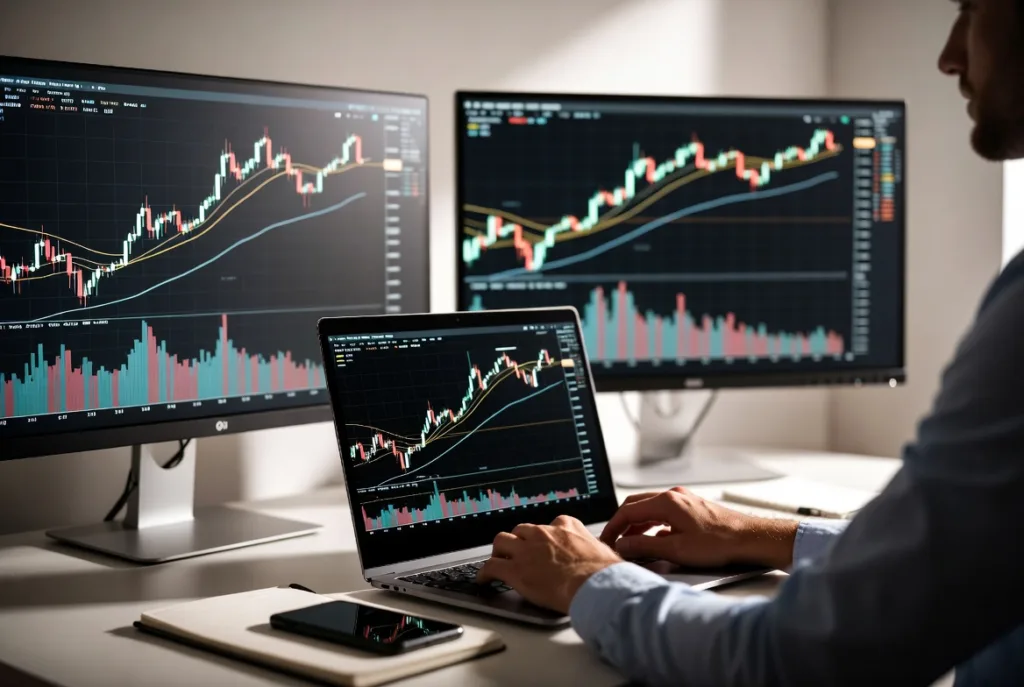
If you’ve ever wondered how some people make money by buying and selling stocks throughout the day while others hold investments for decades, you’re asking the right question. Trading isn’t just “investing but faster”—it’s a completely different approach to financial markets that focuses on capturing short-term price swings rather than waiting for long-term growth.
Maybe you’ve heard stories about day traders making thousands before lunch, or perhaps you’re simply curious about what happens behind those green and red numbers flashing on market screens. Either way, understanding how trading actually functions—beyond the hype and headlines—gives you the foundation to decide whether it fits your financial goals.
This guide walks through everything from basic mechanics to common pitfalls, written for someone who’s never placed a trade but wants to understand what’s really involved.
Trading Meaning in Finance
When financial professionals talk about trading, they’re describing the practice of buying and selling securities—stocks, bonds, currencies, commodities—with plans to exit those positions relatively quickly. We’re talking timeframes measured in minutes, hours, days, or perhaps a few weeks, not the multi-year horizons typical of traditional investing.
The whole point? Profit from price movement itself. Volatility becomes your ally. A trader might purchase 100 shares of Tesla at $245 on Tuesday morning, then sell them Thursday afternoon at $253, capturing that $800 spread (before commissions eat into it).
Here’s what trading isn’t: it’s not gambling, despite what skeptics claim. Yes, both involve uncertainty and risk. But gambling relies on chance—rolling dice or spinning wheels where the house edge guarantees your eventual loss. Trading depends on analyzing patterns, understanding market mechanics, studying company news, and executing a tested plan. You’re making calculated decisions based on available information, not hoping for lucky numbers.
Another myth worth dispelling: you don’t need a Wall Street pedigree or millions in capital to trade. Fifteen years ago, sure—retail traders faced massive barriers. Today? A teenager with a smartphone and $500 can access the same real-time data, order routing, and market depth that professionals use. Technology removed the moat.
How Trading Works
Let’s walk through a typical trade from start to finish. You’re analyzing charts one evening and notice a stock forming a pattern that historically precedes upward moves. You decide to buy 50 shares when markets open tomorrow.
Next morning at 9:30 AM, you open your brokerage app, type the ticker symbol, and enter your order details. Here’s where you face your first real decision: market order or limit order?
A market order says “buy right now at whatever the current price is.” If the stock shows $72.50 when you hit submit, you’ll pay something close to that—maybe $72.52 or $72.48 depending on bid-ask spreads and order flow. Speed is guaranteed; exact price isn’t.
A limit order says “I’ll only buy at $72.25 or better.” You control the price ceiling but sacrifice certainty—if the stock never dips to your limit, you never get filled. It might run to $75 while you’re waiting.
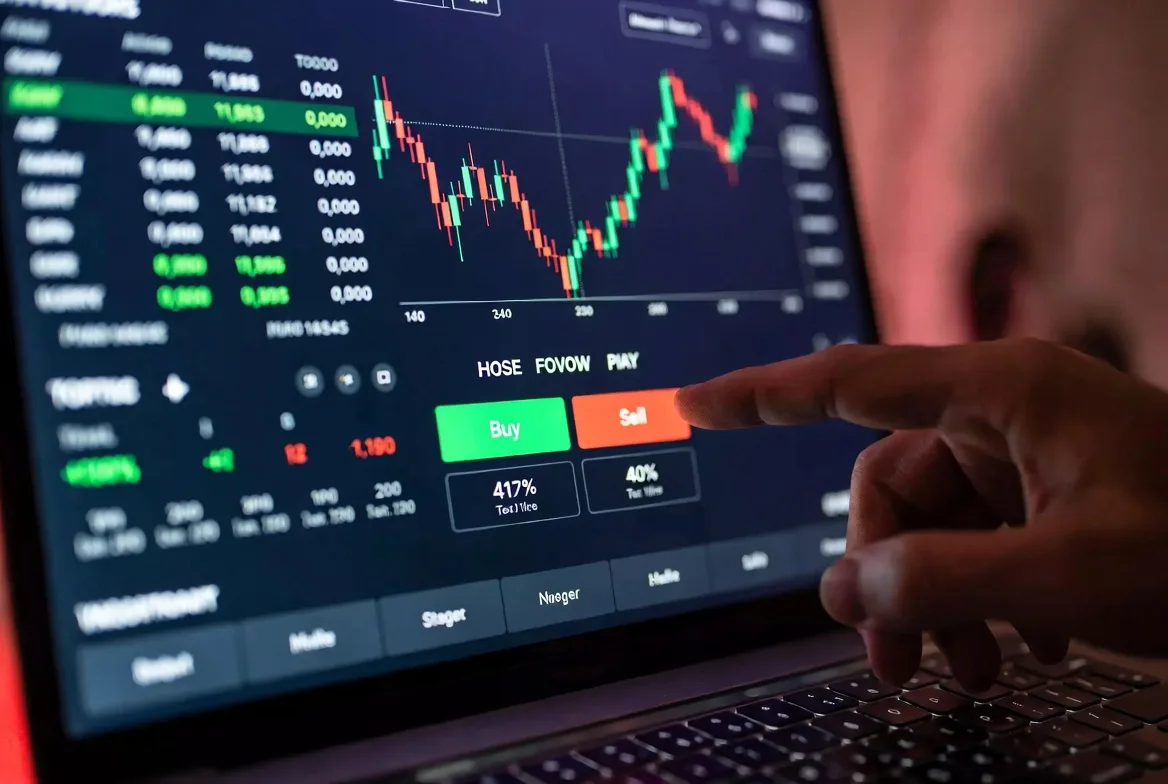
After submitting your order, your broker shoots it through their routing system to exchanges or market makers. For liquid stocks, execution happens faster than you can blink. Suddenly those 50 shares appear in your account under “positions.”
Now you wait. Maybe hours, maybe days. When your analysis suggests it’s time—or your risk management rules trigger an exit—you submit a sell order following the same process in reverse. The difference between entry and exit, multiplied by share count, equals your gross profit or loss. Subtract commissions, and you’ve got your net result.
Brokers make this possible by providing market access you’d never have alone. Most charge either per-trade commissions ($0-$5 typically) or make money through payment for order flow arrangements with market makers. Understanding your broker’s economics helps you grasp why they offer certain features.
Modern platforms bundle way more than just order entry. You get streaming quotes, charting packages with dozens of indicators, news aggregation, watchlists, and risk controls like stop-losses—automated sell orders triggered if your position drops to a specific price, limiting potential damage.
Types of Trading Explained
Trading isn’t one-size-fits-all. Your schedule, personality, and risk appetite determine which style actually works for your situation. The three main approaches differ dramatically in time commitment and how long you hold positions.
Active Trading
Active traders—commonly called day traders—open and close every position before markets shut down for the day. They never hold anything overnight, which eliminates the risk of waking up to bad news that gaps a stock down 10% at the opening bell.
This approach is intense. Picture monitoring three screens simultaneously, tracking order flow data, executing 20-40 trades before lunch, and making split-second decisions worth hundreds or thousands of dollars. Profits come from capturing small moves repeatedly—buying a stock at $48.20, selling it at $48.55 thirty minutes later, doing that pattern all day across multiple tickers.
Who thrives here? People with genuine full-time availability, nerves of steel, and strong emotional control. You’ll also need to understand the Pattern Day Trader rule: if you execute four or more day trades within five business days in a margin account, you must maintain $25,000 minimum equity. That regulatory threshold keeps many newcomers out of pure day trading.
Position Trading
Position traders hold weeks, months, sometimes over a year. They’re playing a longer game that resembles investing in many ways, except they enter with predetermined targets and exit plans rather than indefinite holding intentions.
These traders lean heavily on fundamental analysis. They’re reading earnings transcripts, tracking FDA approval timelines, analyzing macroeconomic data releases. Maybe they identify a biotech company with a promising drug candidate expecting Phase 3 trial results in eight weeks—they buy now, plan to exit within days of the announcement regardless of outcome.
Time requirements? Minimal. Check positions each morning, maybe scan news at lunch, review charts before bed. This works beautifully if you have a demanding day job. The tradeoff involves exposure to after-hours events and weekend news that can move prices dramatically before you can react.
Swing Trading
Swing traders occupy the middle ground, holding anywhere from two days to several weeks. They’re targeting those intermediate moves—the “swings” between major price levels where stocks pause, reverse direction, or consolidate before continuing.
Technical analysis drives decisions here. Swing traders spot patterns like ascending triangles, moving average crosses, or MACD divergences that suggest probable direction over the next several days. When the pattern confirms with volume, they enter. When momentum fades or targets hit, they exit.
You’ll need to check your positions daily—morning and evening reviews usually suffice—but you’re not glued to screens. This balance appeals to people who want more action than position trading provides without the intensity of day trading.
| Style | Typical Hold Time | Daily Time Needed | Risk Factors | Best Suited For |
|---|---|---|---|---|
| Active Trading | Under one day | 6-8 hours continuous | Highest (leverage common, rapid decisions) | Full-time traders with $25,000+ capital |
| Position Trading | Several weeks to months | Under 1 hour | Medium (overnight gaps, news events) | Busy professionals, patient temperaments |
| Swing Trading | 2-20 days average | 1-2 hours | Medium-high (shorter exposure, frequent decisions) | Part-timers seeking regular action |

Trading Strategies for Beginners
Starting with complicated multi-indicator strategies creates unnecessary confusion. These four straightforward approaches give new traders structure without overwhelming complexity.
Trend following relies on the market’s tendency to continue moving in the same direction longer than seems logical. You’re essentially riding momentum. Identify a clear uptrend—each peak higher than the last, each valley above the previous one—then wait for temporary pullbacks to enter. Your exit signal comes when the trend breaks: lower highs, lower lows, or price closing below a key moving average. Simple example: a stock climbs from $30 to $42 over three weeks, then dips to $40. You buy that dip, ride it to $46, then sell when it breaks back below $44.
Support and resistance trading exploits price memory. Certain levels act like magnets where traders repeatedly make decisions. Support marks a floor where buyers historically emerge; resistance forms a ceiling where sellers appear. The strategy: purchase when price approaches proven support, place your stop slightly beneath that level, then sell as it climbs toward resistance. If a stock has bounced off $55 three times over six months, buying at $55.20 with a stop at $54.70 gives you a defined risk while betting on pattern continuation.
Breakout trading captures explosions from consolidation. Stocks often trade sideways for days or weeks, bouncing between narrow ranges. When price finally bursts through resistance on heavy volume, it frequently continues significantly higher as new buyers pile in and algorithms trigger. The trick is confirmation—don’t chase the initial spike. Wait for a daily close above the breakout level. A stock trapped between $68-$71 for two weeks that closes at $71.80 on double normal volume signals a confirmed breakout worth entering.
News catalyst trading means positioning around scheduled events—earnings reports, FDA decisions, economic data. One approach: trade the immediate reaction. Company reports earnings that crush estimates, stock gaps up 6% at open, you buy that initial surge betting institutions will spend the morning accumulating shares. Exit by lunch or end of day before overnight risk enters the picture. This works because markets often underreact initially to significant news, then continue adjusting throughout the session.
Every single one of these requires predetermined risk limits. Before clicking “buy,” know exactly where you’ll exit if you’re wrong. Most professionals risk just 1-2% of total account capital per trade—if you have $10,000, that means $100-$200 maximum loss per position.
Trading vs Investing
People mix up these terms constantly, but they’re fundamentally different approaches with distinct goals, timelines, and risk profiles.
Time horizon creates the biggest split. Investors buy assets planning to hold for five, ten, thirty years. They’re building wealth through compound growth, dividend reinvestment, and the market’s long-term upward bias. Traders operate on compressed timelines—exiting positions in days or weeks—focused on capturing intermediate moves without concern for whether the asset makes a good 20-year hold.
Objectives naturally diverge. An investor putting money into S&P 500 index funds wants steady 8-10% average annual returns, accepting that some years will be down. They’re OK with volatility because their timeline smooths out short-term chaos. A trader pursues returns independent of overall market direction. They might profit during bear markets through short-selling or by trading volatile individual stocks while indices decline.
Risk characteristics differ substantially. Investing carries market risk—the chance your holdings lose value—but time provides a cushion. Someone investing at 30 for retirement at 65 will survive multiple recessions and market crashes. Traders concentrate risk into shorter windows where a single bad week can cause serious damage before any recovery. Add leverage (borrowing to increase position size), common in trading, and losses can exceed your initial capital.
Analysis methods split along fundamental versus technical lines. Investors study financial statements, competitive moats, management track records, industry growth rates. Their question: “Will this company expand earnings over the next decade?” Traders scrutinize price charts, volume patterns, momentum indicators, and order flow. They ask: “Will this stock move higher over the next three days, and does the risk-reward justify entry?”
Tax consequences strongly favor investors. In the U.S., holding any position over 12 months qualifies you for long-term capital gains taxation—0%, 15%, or 20% brackets depending on income. Short-term gains get taxed as ordinary income at rates up to 37%, plus potentially self-employment tax if trading is your primary income source. That difference adds up quickly.
Neither approach is objectively “better.” Investing builds wealth passively with minimal time investment. Trading offers active engagement, faster feedback loops, and income potential for those who develop skills. Plenty of people maintain a long-term investment portfolio for retirement while trading a separate account for current income or skill development.
Common Mistakes New Traders Make
Learning from others’ mistakes beats paying for your own education unnecessarily. These five errors drain accounts regardless of strategy quality.

Overtrading destroys beginners faster than anything else. Easy market access creates temptation to take every marginally interesting setup. More activity feels productive—except each trade carries commission costs, bid-ask spreads, and opportunity for error. Quality beats quantity decisively. Professional traders often execute fewer than five setups weekly, waiting for high-probability situations. If you can’t state your trade thesis in one clear sentence (“buying this breakout because…”), skip it.
Skipping risk management transforms profitable strategies into account killers. Trading without stop-losses is like driving without seatbelts—fine until it isn’t, then catastrophic. A single position allowed to hemorrhage unchecked can erase months of careful gains. Here’s sobering math: losing half your account requires 100% returns just to break even. Lose 25%, you need 33% gains to recover. Protecting capital comes before chasing profits, every time.
Revenge trading creates downward spirals. You take a loss, emotions flare, and suddenly you’re forcing trades to “get back” what you lost. This rarely works—impulsive decisions made while angry or desperate almost always compound the problem. Solution: enforce a rule that two consecutive losers trigger an immediate break. Walk away for the rest of the session, return tomorrow with a clear head.
Unrealistic expectations cause premature quitting. New traders often expect profitability within weeks, then abandon everything after initial setbacks. Developing genuine competence requires 6-12 months of consistent practice, journal review, and pattern recognition. Your first year is education, not income—size positions accordingly and focus on executing your process correctly rather than counting profits.
Poor position sizing creates unrecoverable risk. Beginners frequently risk 10-20% per trade, thinking bigger bets mean faster profits. Three consecutive losses—completely normal even with solid strategy—and you’re down over 50%. Professional risk management limits single-trade exposure to 1-2% of account size, allowing survival through inevitable rough patches.
What matters most is making high-quality trades. Profits are simply the byproduct of consistently good decisions.
Dr. Alexander Elder
That perspective shift—from chasing dollars to perfecting process—separates traders who last from those who flame out within months. Execute your strategy properly and profits accumulate naturally over time.
FAQs
Many brokers accept accounts starting at $100, but practical minimums depend heavily on your approach. Day trading requires $25,000 due to pattern day trader regulations. Swing traders should start with $1,000-$5,000 minimum—enough to open 3-5 positions simultaneously while risking only 1-2% per trade. You could begin with less, but commission impact becomes significant and proper position sizing becomes nearly impossible. Start small, but not so small that execution costs devour your edge.
Generally yes, because compressed timeframes amplify volatility impact. An investor might watch their holdings drop 20% over a year—uncomfortable but survivable with time. A trader faces that same stock swinging 5% daily, creating far more opportunities for poor timing. Leverage use in trading multiplies both gains and losses beyond invested capital. That said, risk becomes manageable through proper position sizing, stop-losses, and strategy discipline. The real danger comes from treating trading casually rather than as a skill requiring serious study.
Technically possible, practically difficult. Consistent profitability demands substantial capital—most full-timers suggest $100,000 minimum to generate livable income—along with refined skills, psychological discipline, and years of experience. The majority of retail traders lose money, especially initially. Most successful full-time traders spent years trading part-time while supported by other income, transitioning only after multiple years of demonstrated consistency. Treat trading as a part-time pursuit initially; consider full-time only after proving yourself over multiple market cycles.
Swing trading offers the most balanced entry point for newcomers. It provides sufficient opportunities to build experience without the pressure and capital requirements of day trading. Multi-day holding periods allow time for thoughtful analysis rather than forcing snap decisions under pressure. Position trading works if you’re extremely patient, but slow feedback delays skill development. Start with swing trading, adjust later based on what you discover about your schedule and temperament through actual experience.
Not initially. Most broker platforms include adequate tools for beginners: streaming quotes, basic charting capabilities, news feeds, standard order types. As your skills develop, dedicated charting applications—TradingView, Thinkorswim, TC2000—offer superior technical analysis features worth considering. Day traders eventually invest in premium market data, multiple monitors, and high-speed internet connections. Swing and position traders often succeed long-term with standard broker platforms. Start with what’s included; upgrade only when you identify specific limitations affecting your strategy execution.
Plan on 6-12 months of dedicated study and practice before reaching basic competency, then 2-3 years before consistent profitability becomes realistic. This assumes regular market observation, strategy testing, detailed trade journaling, and continuous learning. Some people grasp concepts faster; others need more time—no shame either way. Learning never truly ends because markets evolve constantly, requiring ongoing adaptation. Think of trading like learning piano or mastering a foreign language rather than a weekend certification course.
Trading offers an engaging way to participate in financial markets beyond traditional buy-and-hold investing, but success demands far more than opening an account and clicking buttons. Understanding core mechanics—order execution, different trading styles, typical pitfalls—provides the foundation for making informed decisions rather than impulsive bets.
Choosing between active trading, position trading, or swing trading depends entirely on your schedule, available capital, and personality. Most beginners benefit from swing trading strategies focused on trends or support-resistance levels, always emphasizing risk control over profit maximization.
Remember that trading operates under completely different rules than investing regarding timeframes, objectives, and risk management. Both approaches have merit; neither is universally superior. Your personal financial goals and lifestyle should determine which path—or combination—makes sense for your situation.
Above all, respect the learning curve. Traders who survive their first year and eventually thrive treat that initial period as education rather than income generation. They risk small amounts, maintain detailed journals, and obsess over executing their strategy correctly instead of watching profit-loss totals.
Markets open tomorrow, next month, next year. There’s no deadline forcing you to rush. Build knowledge systematically, develop emotional discipline, and approach trading as a long-term skill acquisition project rather than a get-rich-quick shortcut.